
The Growing Role of Molecular Ecology in Regulation
Type your paragraph here
From DNA to Environmental Decisions: The Growing Role of Molecular Ecology in Regulation
Sudha Venkatesan, Scientist, Department of Ecotoxicology
Introduction
Environmental regulation increasingly depends on reliable information about biodiversity, ecosystem health, pollution, and the spread of invasive species. Traditional ecological surveys remain essential, but they can be time-consuming and may miss rare, cryptic, or difficult-to-sample organisms. Molecular ecology provides additional tools that allow scientists and regulators to detect biological information from genetic material found in organisms and their environments.
One of the most important developments is environmental DNA (eDNA) – DNA released by organisms into water, soil, sediments, or air. Through DNA sequencing, metabarcoding, and quantitative PCR (qPCR), researchers can detect species and characterize biological communities without necessarily capturing the organisms themselves (1 & 2).
What is Molecular Ecology?
Molecular ecology combines ecology, genetics, molecular biology, and bioinformatics to study organisms and their interactions using genetic information.
Important techniques include:
- Environmental DNA (eDNA) – detecting DNA shed by organisms into their surroundings.
- DNA metabarcoding – identifying many species from a single environmental sample.
- DNA barcoding – identifying organisms using characteristic genetic sequences.
- qPCR and digital PCR – detecting and, in suitable circumstances, quantifying specific genetic targets.
- Genomics and population genetics – examining genetic diversity, connectivity, population structure, and evolutionary processes.
These techniques can complement conventional ecological surveys and generate information useful for environmental management and regulatory monitoring (3 & 4).
Environmental DNA (eDNA) Workflow: Process, Advantages, and Opportunities
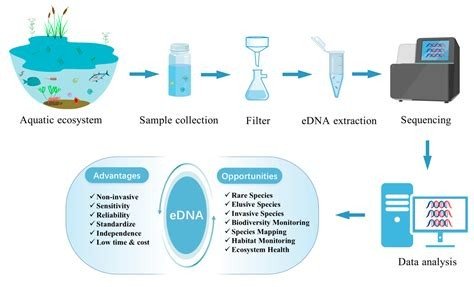
Image source: Chang, H., Ye, T., Xie, Z., & Liu, X. (2025). Application of Environmental DNA in Aquatic Ecosystem Monitoring: Opportunities, Challenges and Prospects. Water / MDPI.
1. Biodiversity Monitoring and Regulation
A major contribution of molecular ecology is the ability to monitor biodiversity more efficiently.
For example, a water sample can contain DNA from fish, amphibians, microorganisms, plants, and other organisms. After DNA extraction and sequencing, researchers can obtain a profile of the biological community present in the sampled environment.
This can help environmental authorities:
- establish biodiversity baselines
- monitor protected habitats
- detect changes in species composition
- investigate ecological impacts of development
- monitor restoration projects and
- provide additional evidence for environmental management.
Research reviews describe eDNA metabarcoding as applicable across aquatic and terrestrial environments and to a wide variety of biodiversity-monitoring questions (2).
2.Early Detection of Invasive Species
Invasive species can cause substantial ecological and economic impacts. Molecular ecology offers a way to search for their genetic signatures before conventional surveys have clearly documented established populations.
For example, water samples can be screened for DNA belonging to a particular invasive fish, mollusc, plant, or microorganism. This can support early-warning and biosecurity programmes.
Because detection does not necessarily require physically capturing the organism, eDNA can be particularly useful when the target species is rare or difficult to observe. Reviews identify invasive-species detection as one of the important applications of eDNA monitoring (1 & 3).
3.Monitoring Threatened and Endangered Species
Molecular ecology can also support conservation regulations by helping determine whether threatened species occur in a particular habitat.
Instead of repeatedly disturbing sensitive habitats to search for animals, scientists can sometimes collect environmental samples and look for species-specific DNA.
For endangered freshwater mussels, for instance, recent research describes eDNA as a complementary monitoring method for confirming the presence of rare, threatened, and endangered species. However, regulatory use requires validated assays, standardized procedures, reproducibility, and careful consideration of false-positive and false-negative detections (5).
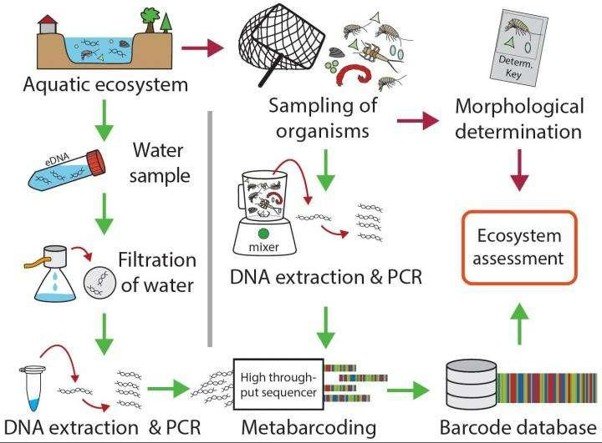
Image Credit: Adapted from the DNAqua-Net project proposal published in the Research Ideas and Outcomes Journal, licensed under CC BY 4.0.
4.Supporting Pollution and Ecosystem-Health Assessment
Environmental regulation often requires authorities to determine whether human activities are affecting ecosystems.
Molecular approaches can reveal changes in biological communities associated with environmental disturbance. Instead of measuring only chemical parameters such as nutrients or contaminants, molecular monitoring can provide information about which organisms are present and how biological communities are changing.
Studies have explored the use of eDNA for assessing biodiversity and ecosystem responses to environmental pressures. Molecular data can also be combined with ecological and statistical models to interpret complex environmental changes (6).
A simplified regulatory pathway
Environmental sample → DNA extraction → PCR/sequencing → Bioinformatics → Species/community detection → Ecological interpretation → Regulatory monitoring
This workflow illustrates how molecular measurements can become part of a broader evidence chain rather than being treated as an isolated laboratory result.
5.Improving Environmental Impact Assessment
Environmental Impact Assessment (EIA) requires information about the organisms and ecosystems that could be affected by a proposed activity.
Molecular ecology can strengthen baseline surveys by detecting species that conventional methods may overlook. A single environmental sample can potentially contain genetic traces from numerous taxa.
This could be particularly useful when assessing:
- infrastructure development
- mining and industrial projects
- wetlands and rivers
- coastal and marine developments
- habitat restoration and
- protected areas.
However, molecular evidence works best when combined with information about habitat, abundance, population status, and ecological processes.
6.Creating More Standardized Monitoring Systems
One of the most important contributions of molecular ecology to regulation may be standardization.
For regulatory monitoring to be credible, results need to be reproducible. This requires consistent approaches to:
- sample collection
- contamination prevention
- DNA extraction
- molecular assays
- sequencing
- bioinformatics
- reference databases
- quality control and
- interpretation.
Researchers have emphasized that uncertainty can occur at every stage of the eDNA workflow, from sampling through laboratory analysis and data interpretation.
Therefore, regulatory adoption should involve validation and quality-assurance procedures rather than simply replacing traditional surveys with DNA tests.
7.Contribution to Biodiversity Policy and Governance
The potential regulatory value of molecular ecology extends beyond individual monitoring programmes. International biodiversity frameworks increasingly require reliable information about biodiversity change.
Recent research has specifically examined how eDNA-generated biodiversity information could contribute to implementation of the Kunming–Montreal Global Biodiversity Framework, including monitoring invasive species, species recovery, pollution impacts, and ecosystem resilience (7).
Research published in 2026 has also explored how eDNA monitoring could connect biodiversity data with governance and reporting frameworks, while emphasizing the need to translate molecular detections into robust ecological indicators.
Challenges in Regulatory Use
Despite its potential, molecular ecology is not a substitute for all conventional ecological monitoring.
Important challenges include:
- False positives and false negatives
DNA may be detected even when a living population is not currently present at the sampling location, while a species may go undetected despite being present.
- DNA transport and persistence
DNA can move through water and other environmental pathways. Its persistence also varies with environmental conditions.
- Reference databases
Correct species identification depends partly on the quality and completeness of genetic reference databases.
- Standardization
Different laboratories and sampling protocols can produce different results. Regulatory applications therefore require validated and standardized methods.
- Interpretation
Detecting DNA does not automatically provide information about population size, biomass, reproductive success, or ecosystem function.
These limitations explain why current regulatory applications often treat eDNA as complementary evidence, rather than as an automatic replacement for established biological surveys (5 & 4).
The Future of Molecular Ecology in Regulation
The future is likely to involve integration rather than replacement.
A regulatory monitoring programme could combine:
Molecular data + conventional field surveys + environmental chemistry + remote sensing + ecological modelling
Artificial intelligence and machine-learning approaches may further help interpret large molecular datasets. Research has already demonstrated the potential for combining eDNA data with machine-learning models to distinguish biological communities associated with different environmental conditions (6).
The result could be environmental monitoring systems that are more frequent, spatially extensive, and capable of detecting biological change at an early stage.
Conclusion
Molecular ecology is becoming an important component of modern environmental monitoring and regulatory science. Through eDNA, DNA metabarcoding, qPCR, genomics, and related technologies, regulators and scientists can obtain new information about biodiversity, invasive species, threatened organisms, and ecosystem change.
Its greatest contribution is not simply that it provides a faster way to identify species. Rather, molecular ecology creates new forms of biological evidence that can complement traditional ecological observations and support evidence-based environmental management.
For molecular methods to become reliable regulatory tools, however, continued work is needed on standardization, validation, quality assurance, reference databases, interpretation, and integration with conventional ecological evidence.
Molecular ecology is helping move environmental regulation from occasional observation toward more sensitive, data-rich, and potentially near-real-time biodiversity monitoring.
References:
- Banerjee, P., Dey, G., Antognazza, C. M., Sharma, R. K., Maity, J. P., Chan, M. W. Y., … & Chen, C. Y. (2021). Reinforcement of Environmental DNA Based Methods (Sensu Stricto) in Biodiversity Monitoring and Conservation: A Review. Biology.
- Keck, F., Brantschen, J., & Altermatt, F. (2023). A combination of machine-learning and eDNA reveals the genetic signature of environmental change at the landscape levels. Molecular Ecology.
- Lopez, M. L. D., Acharya-Patel, N., Allison, M. J., Migneault, A., Trilesky, S., & Helbing, C. C. (2026). From environmental DNA into actionable biodiversity data: Towards the implementation of the Kunming-Montreal Global Biodiversity Framework. Journal of Heredity.
- Nagarajan, R. P., Bedwell, M., Holmes, A. E., Sanches, T., Acuña, S., Baerwald, M., … & Schreier, A. (2022). Environmental DNA Methods for Ecological Monitoring and Biodiversity Assessment in Estuaries. Estuaries and Coasts.
- Rahman, M., Rahman, M. S., & Kline, R. J. (2026). Environmental DNA for endangered freshwater mussel monitoring: a review on global synthesis of eDNA methods, challenges, and innovative strategies. Frontiers in Conservation Science.
- Ruppert, K. M., Kline, R. J., & Rahman, M. S. (2019). Past, present, and future perspectives of environmental DNA (eDNA) metabarcoding: A systematic review in methods, monitoring, and applications of global eDNA. Global Ecology and Conservation.
- Zhang, M., Zou, Y., Xiao, S., & Hou, J. (2023). Environmental DNA metabarcoding serves as a promising method for aquatic species monitoring and management: A review focused on its workflow, applications, challenges and prospects. Marine Pollution Bulletin.


Leave a Reply